Types of Neon Signs: The Complete Taxonomy
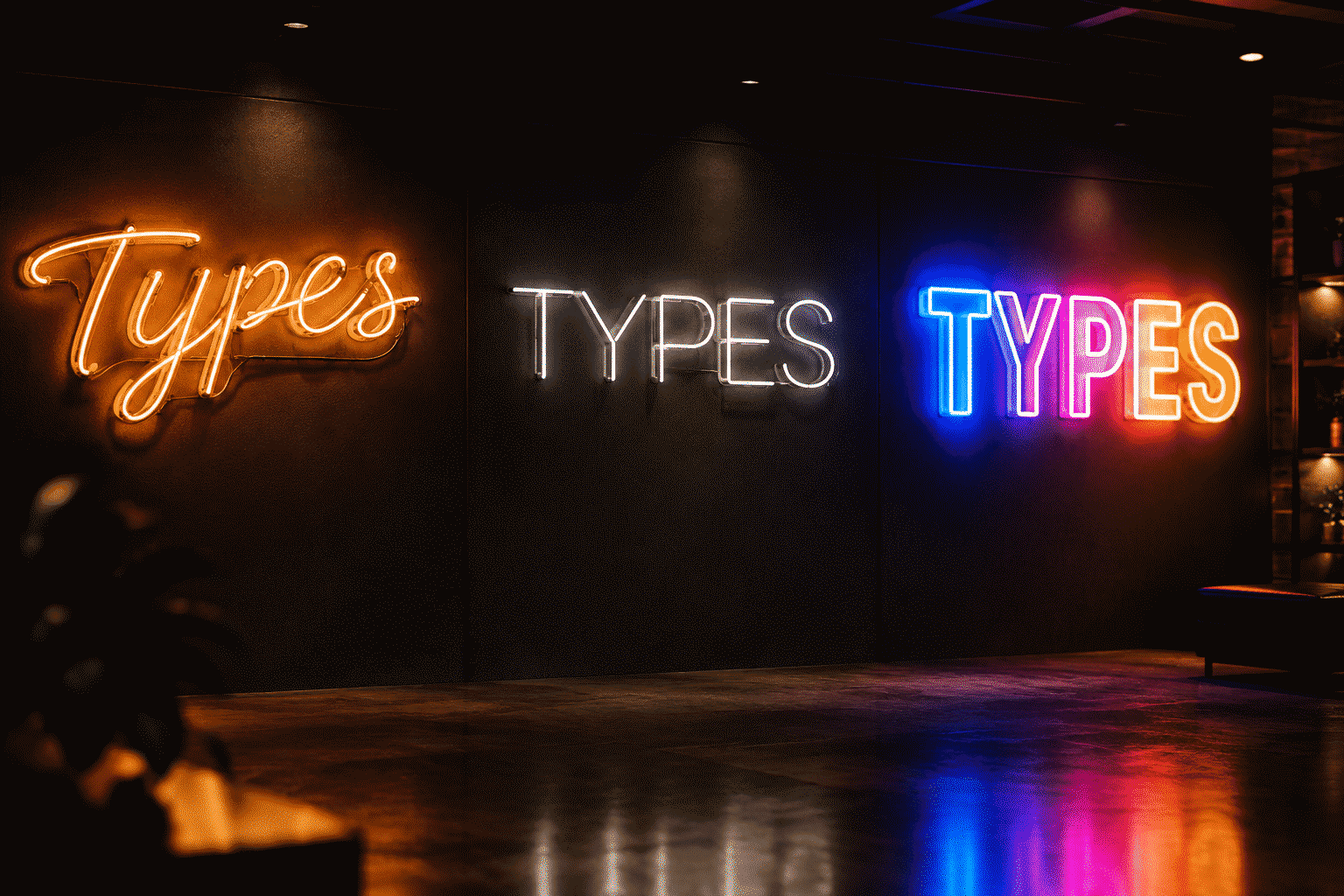
Neon signs sort cleanly along three axes: technology (what makes the light — glass gas-discharge, LED flex, edge-lit acrylic, UV print hybrids), form (what shape the sign takes — wordmark, icon, logo, open sign, sculpture), and purpose (where it serves — home, event, business, art). Most “types of neon signs” lists flatten one axis and gesture at the rest; the full taxonomy is three dimensions, and knowing all three is what makes you fluent in the market — you’ll specify exactly what you want instead of circling categories.
The definitional basics live at what are neon signs; this page is the complete sort.
Axis 1: By Technology
Glass neon (gas discharge). The original: hand-bent glass tubes, noble gas fills, kilovolt transformers. The craft tier — deepest halo, heritage value, professional installation. Now the minority of the market but the soul of it (the comparison).
LED flex neon. The modern standard: diode strips in silicone tubing, formed to design on acrylic backing, 12–24 volts. Roughly everything sold as “neon” online today — dimmable, RGB-capable, safe, consumer-priced (the anatomy).
LED neon + UV print hybrids. LED neon lettering or outlines combined with UV-printed full-color panels — the format that adds photographic imagery, detailed logos, and gradient backgrounds to the glow. Common in business signage where the full logo (not just its outline) must appear (the UV format).
Edge-lit acrylic (LED, not “neon” proper). Light piped into engraved acrylic so the engraved lines glow — the sleeker, flatter cousin used for awards, directional signage, and minimalist plaques. Included here because buyers meet it in the same searches and it solves some of the same problems.
Axis 2: By Form
Wordmarks and phrases. The dominant modern format: words, names, short phrases in script or block (the design rules). Includes the names-and-dates event staple.
Icons and shapes. Hearts, bolts, moons, arrows, palms, lightning — meaning without vocabulary (the icon vocabulary). The format of kids’ rooms, accents, and icon-over-word layering.
Logos and brand marks. Business conversions of existing logos to glow — the custom work where design files matter (the business line).
Open signs and business vernacular. “OPEN,” “BEER,” “VACANCY” — the standardized commercial words with their own design conventions (the genre).
Sculptural and dimensional work. Free-standing pieces, wrapped objects, multi-layer builds — the art-adjacent tier where the sign stops being signage (art lineage).
Interactive and dynamic builds. Color-changing RGB walls, sound-reactive pieces, app-controlled installations — the technology showpieces (the smart layer).
Axis 3: By Purpose
Home decor signs — bedroom phrases, kids’ rooms, man caves, home bars: warm, personal, dimmable. The largest modern category.
Event signage — weddings, parties, corporate: names-and-dates, backdrops, portable formats. Battery-capable, one-night-to-forever lifespans (the playbook).
Business signage — storefront identity, open signs, interior atmosphere, trade show displays. The commercial tier with durability and brightness requirements (the B-end guide).
Art and gallery work — one-offs and editions in the light-art lineage (the history).
Heritage and restoration — vintage pieces and museum-grade reconstructions (the vintage world).
The Quick-Reference Matrix
| You want… | Technology | Form | Purpose lane |
|---|---|---|---|
| Your name over the bed | LED flex | Wordmark | Home |
| Wedding names-and-dates | LED flex | Wordmark | Event |
| Storefront identity | LED flex (+UV print for full logos) | Logo | Business |
| “OPEN” in the window | LED flex | Vernacular | Business |
| The authentic craft glow | Glass | Any | Heritage/identity |
| A heart in the nursery | LED flex | Icon | Home |
| Museum-grade piece | Glass | Sculptural | Art |
Specifying Fluently (What the Taxonomy Buys You)
Once the three axes are native, ordering gets precise: “LED flex, cut-to-shape backing, single warm-white wordmark, 36 inches, dimmable” says everything a maker needs (backing options, measurement). Compare that to “a neon sign for my room” — the difference between the taxonomy and the blur.

Browse the finished examples across every category in the collections, or specify your exact coordinates in the custom builder — technology, form, and purpose all configurable in one session.
Choosing Within the Taxonomy: Worked Examples
The three-axis taxonomy applied — five briefs resolved into specifications:
The nursery brief. Purpose: home. Form: icon-plus-wordmark (name plus a star). Technology: LED flex, warm white, cut-to-shape, dimming integrated. The taxonomy coordinates that decided everything: home-purpose pulls warm/dimmable specs (the bedroom logic); the icon-plus-word form carries name and charm in one piece; the technology tier follows from safety-by-default. Specification complete in one pass.
The coffee shop brief. Purpose: business — interior atmosphere plus window presence. Form: wordmark (shop name in script) plus vernacular (“OPEN” for the window). Technology: LED flex both, with the window piece outdoor-rated (the ratings); warm white and amber the register (the café logic). Two signs, two jobs, one coordinate system.
The collector’s centerpiece brief. Purpose: heritage. Form: sculptural — the vintage piece defines its own form. Technology: glass, restored and documented (the vintage path). The taxonomy’s use here is knowing what everything else in the collection should be (LED accents that complement rather than compete) — the coordinates position the supporting cast around the star.
The event stylist’s kit brief. Purpose: event, recurring. Form: modular — wordmark pieces plus icon set, battery-capable. Technology: LED flex throughout, dimming standard, travel-grade backing (the event playbook). The stylist’s kit is the taxonomy’s mobility column embodied: every piece specified for the road.
The streamer’s upgrade brief. Purpose: home-plus-content (the dual-purpose coordinate most modern briefs carry). Form: wordmark (the handle) plus icon (bolt or brand glyph). Technology: LED flex, RGB for palette flexibility (the color-changing layer), camera-calibrated dimming (the photography specs). The brief that made the taxonomy’s purpose axis multi-valued — and it’s now the commonest brief in the market.
The worked examples’ lesson: specification flows from coordinates in every case — fix the purpose, form, and technology, and the sign designs itself. Fluency in the taxonomy is what turns “I want a neon sign” into “LED flex wordmark, warm white, 36 inches, cut-to-shape, dimmable” — the sentence every maker can build from (try yours here).
FAQ: Types of Neon Signs
What are the main types of neon signs? By technology: glass gas-discharge, LED flex (the modern standard), LED+UV-print hybrids, and edge-lit acrylic. By form: wordmarks, icons, logos, business vernacular, sculpture. By purpose: home, event, business, art, and heritage — the full three-axis taxonomy above.
What’s the difference between glass neon and LED neon signs? Glass is the hand-crafted original (gas in bent glass at kilovolts — deepest halo, professional install); LED flex is the modern majority (diodes in silicone at 12–24 volts — cheaper, safer, dimmable, RGB-capable). The full comparison lives in our head-to-head.
What type of neon sign is best for a bedroom? LED flex wordmark or icon, single warm color, cut-to-shape backing, dimmable — the taxonomy coordinates for the largest modern category (bedroom guide).
What are UV printed neon signs? LED neon lettering or outlines combined with UV-printed full-color acrylic panels — the hybrid that puts photographic logos and gradients into the glow, common in business signage.
Which type of neon sign is cheapest? LED flex in standard sizes and single colors — the consumer tier the custom market is built on. Stocked designs undercut customs further; glass neon is the premium craft tier at multiples of LED pricing.
Are edge-lit signs the same as neon signs? Different mechanism, adjacent market: edge-lit acrylic glows along engraved lines via side-fired LEDs — sleeker and flatter than neon forms, used for awards, plaques, and directional signage. The taxonomy’s closing note: fluency is the entire value — three axes (technology, form, purpose) turn browsing into specifying, and specifying is how custom work gets what buyers actually wanted (the worked examples). The medium’s hundred-plus formats all reduce to coordinates on those three axes, and every maker’s order form is secretly asking for them. Answer in coordinates and the sign designs itself — in the builder, where the axes are sliders.
Three Questions to Fluency
Test yourself before the next browse: what technology should a bedroom wordmark be, and why (LED flex — safety, dimming, price (the case))? What form suits a wedding names piece (wordmark, warm white, cut-to-shape (the format))? What purpose-tier does a museum restoration belong to (heritage — professional service, conservation discipline (the tier))? Three for three and the taxonomy is yours — every listing you meet reads as coordinates, and every order you place says exactly what you mean (the builder speaks coordinates natively).
And when in doubt inside any axis, default to the modern middle: LED flex technology, wordmark form, home purpose, warm white glow — the configuration the market itself converged on by volume, and the coordinates most rooms mean when they say they want a neon sign (build it).
The three-axis map also future-proofs: new formats (new smart features, new hybrid print techniques, whatever the medium invents next) slot into the taxonomy as new coordinates rather than exceptions — the classification was built on the axes that change slowest, which is what makes it durable.
Browse every coordinate in the collections (the catalogs) or jump straight to specifying your own — either way, the taxonomy travels with you. Fluency achieved, the market reads differently forever — that is the taxonomy final promise.
Sources & Further Reading
- Neon: Strong Lines (NIST Physical Reference Data) — the standard reference for neon’s emission wavelengths.
- Solid-State Lighting (U.S. Department of Energy) — DOE reference on LED efficacy and lifetime.
- Neon sign (Wikipedia) — the consolidated public record of neon-sign history and technology.
- Mercury (U.S. EPA) — federal guidance on mercury exposure and safe handling.